Are You Working on the Right Projects?
Entrepreneurs never run out of things to work on.
New ideas show up constantly.
Opportunities appear.
Problems need solving.
The challenge usually isn’t what to do.
It’s deciding what deserves your time first.
Because not all work creates the same value.
And one of the biggest reasons business owners feel stuck—even when they’re busy—is that they’re spending time on the wrong things.
Why Being Busy Isn’t Enough
Many entrepreneurs operate in constant motion.
They’re checking things off their list.
Solving problems.
Working long hours.
But at the end of the week, they still feel like progress is slower than it should be.
Why?
Because activity does not always equal impact.
That’s where a simple but powerful framework comes in.
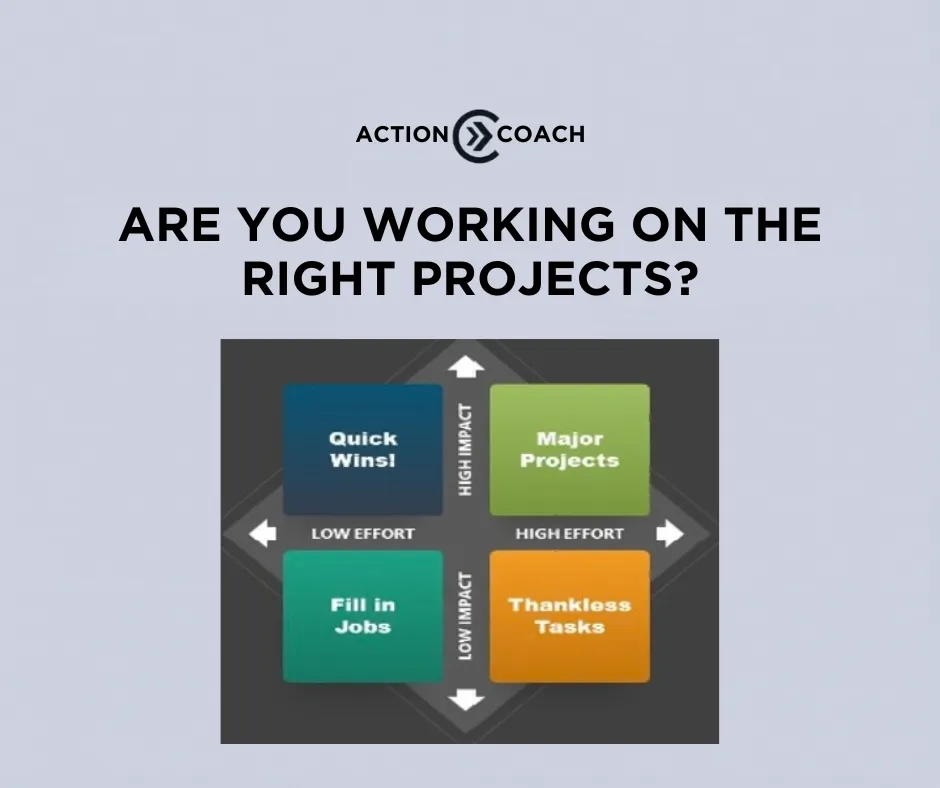
The Effort–Impact Matrix
The Effort–Impact Matrix helps you evaluate your work based on two key factors:
How much effort a task requires
How much impact that task will have on your business
When you map your projects into this framework, four clear categories emerge.
1. High Impact / Low Effort
Quick Wins
These are the first things you should prioritize.
Small improvements that create meaningful results.
Examples include:
Improving a sales script
Following up with past customers
Fixing a simple process issue
Quick wins build momentum.
They create immediate results and often require far less effort than expected.
2. High Impact / High Effort
Major Projects
These are the initiatives that can significantly move your business forward.
But they require planning, time, and resources.
Examples include:
Launching a new service
Hiring key leadership
Implementing better systems
These projects are essential—but they must be managed strategically.
Without planning, they can become overwhelming.
3. Low Impact / Low Effort
Fill-In Tasks
These tasks are easy to complete, but they don’t produce major results.
They’re not harmful—but they’re not where growth comes from.
They can be useful in small doses, especially between larger projects.
But they should never take priority over higher-impact work.
4. Low Impact / High Effort
Time Traps
This is the most dangerous category.
These projects consume time, energy, and attention—but produce very little return.
Examples might include:
Over-engineering internal systems
Perfecting details customers don’t notice
Spending excessive time on low-value tasks
These activities create the illusion of progress…
But in reality, they slow the business down.
The Real Shift for Entrepreneurs
The most successful business owners don’t just work harder.
They become more intentional about where they invest their effort.
They prioritize:
Quick wins for momentum
Major projects for growth
And they minimize:
Fill-in tasks
Time traps
Because the difference between movement and progress often comes down to one thing:
Focus.
A Simple Reflection
Take a look at your current projects and ask yourself:
Which ones are quick wins?
Which ones are major projects that need planning?
Which ones are just filling time?
Which ones might actually be time traps?
This level of awareness can completely change how you approach your work.
Final Thought
Entrepreneurs don’t lack ideas.
They lack clarity on which ideas matter most.
Because success isn’t about doing more.
It’s about doing more of what actually works.
Ready to focus on what actually moves your business forward? Book your strategy call today.