Why Change Is So Hard in Business
Every business owner eventually reaches a point where they know something needs to change.
Growth has stalled.
Profits aren’t where they should be.
The team isn’t aligned.
Processes start breaking down.
Recognizing the need for change is usually the easy part.
Actually making change happen is where most businesses get stuck.
Why Change Feels So Difficult
If change were easy, every business would evolve quickly.
But most don’t.
Instead, they stay in familiar patterns—even when those patterns are no longer producing the results they want.
Why?
Because change isn’t just about strategy.
It’s about overcoming resistance.
Fear of the unknown.
Comfort with existing habits.
Uncertainty about what will happen next.
That’s why having a framework for change is so powerful.
The Formula for Change
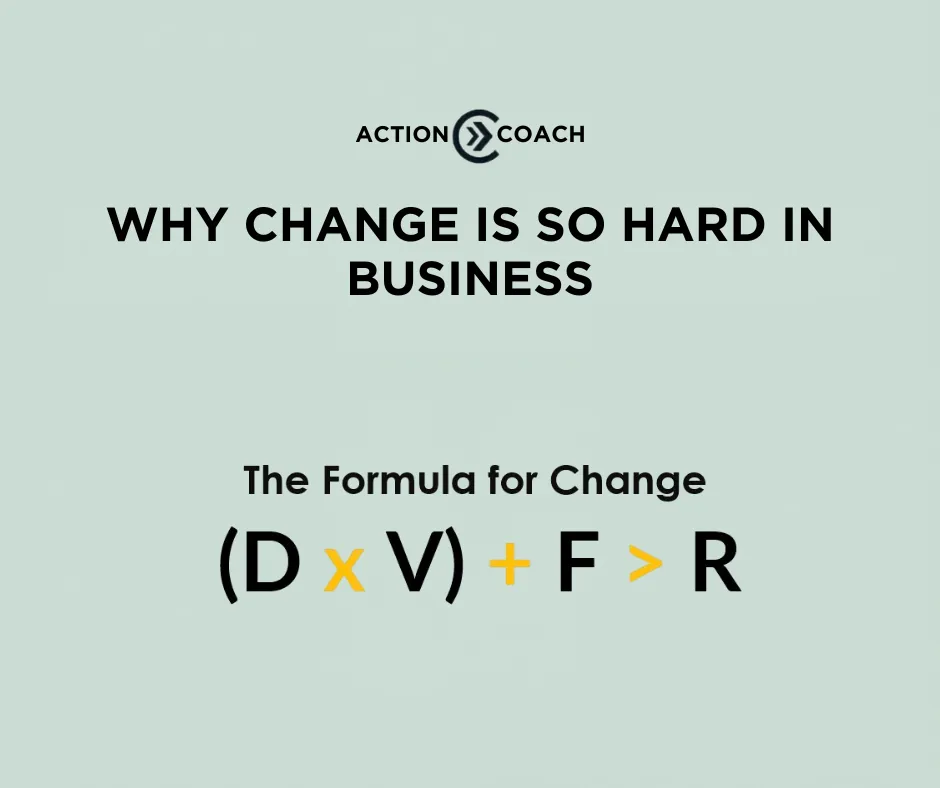
One of the simplest and most effective ways to understand how change actually happens is through a concept often used in business coaching: (D X V) + F > R
This formula explains why some businesses successfully change—and others stay stuck.
D = Dissatisfaction
Change begins when the current situation is no longer acceptable.
Something isn’t working.
The results aren’t there.
The stress is increasing.
The business isn’t where it should be.
Without dissatisfaction, there is no reason to change.
If things feel “good enough,” most people won’t take action.
V = Vision
Dissatisfaction alone creates frustration.
Vision creates direction.
Vision answers the question:
What does success look like?
What would the business look like if it were working the way it should?
More profitable
More structured
Less dependent on the owner
A stronger team
More time freedom
Without vision, dissatisfaction leads to stress.
With vision, dissatisfaction leads to movement.
F = First Steps
Even with dissatisfaction and vision, many business owners still don’t move forward.
Why?
Because the gap between where they are and where they want to be feels too big.
That’s where first steps come in.
Change doesn’t happen all at once.
It starts with one clear, manageable action.
A conversation
A decision
A system
A shift in how time is used
Momentum begins with action.
R = Resistance
Every change encounters resistance.
It shows up as:
Fear
Doubt
Old habits
Comfort with the familiar
Resistance is natural.
It’s not a sign that something is wrong.
It’s a sign that something is changing.
How Change Actually Happens
For change to occur, the formula must hold true:
Dissatisfaction × Vision + First Steps must be greater than Resistance.
If resistance is stronger, nothing changes.
If dissatisfaction is low, there’s no urgency.
If vision is unclear, there’s no direction.
If first steps aren’t defined, there’s no movement.
But when all three come together…
Progress begins.
Why Businesses Stay Stuck
Most businesses don’t fail because they don’t know what to do.
They stay stuck because:
The discomfort isn’t strong enough
The vision isn’t clear enough
The next step isn’t defined
So resistance wins.
And the business stays where it is.
A Simple Reflection
If you’re thinking about change in your business, ask yourself:
What am I dissatisfied with right now?
What does the ideal future actually look like?
What is one step I could take this week?
Clarity in these three areas often unlocks progress.
Final Thought
Meaningful change rarely happens by accident.
It happens when leaders decide:
The future needs to be better than the present—and they’re willing to take the first step to make it happen.
Let's turn this into Action. Book your strategy call today.